Latest News


Press freedom threatened by political instability -RSF
May 03, 2023
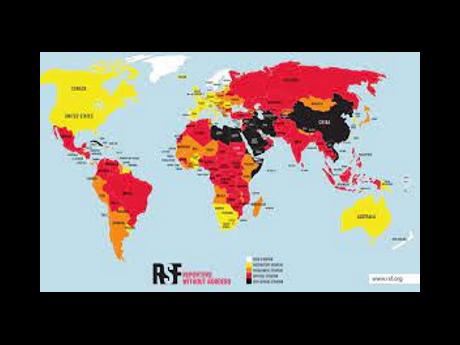
BRIDGETOWN, Barbados, May 3, CMC – The international non-profit organisation, Reporters Without Borders (RSF) has given Caribbean Community (CARICOM) countries mixed grades in its 21st edition of the World Press Freedom Index.
The index, which is compiled annually by RSF sheds light on major and often radical changes linked to political, social and technological upheavals.
With regards to the Americas, it said political transitions have mainly benefited journalists from two countries in the Americas with both Brazil and the United States showing a much better disposition towards the media.
In Haiti, which dropped by 29 to 99th position, RSF said that the growing political instability since President Jovenel Moïse’s assassination in 2021 “has created an acute security crisis that has turned Haiti into one of the region’s most dangerous countries for journalists”.
“In the Caribbean region, Trinidad and Tobago (25th) progressed rather significantly. This is mainly attributed to a Supreme Court ruling in favour of protecting journalists’ sources, which could hold far-reaching implications for media across the region,” RSF said.
According to RSF, Trinidad and Tobago topped the CARICOM countries placing 25th five places down from the 2022 position with a score of 76.54, followed by Jamaica at 32nd with a score of 75.8 down 20 places from the previous year. The RSF looked at 28 countries in the Americas.
Suriname has been pegged at 48th with a score of 70.62 down four places, while Belize is placed at 51st with a score of 70.49, down four places from last year’s position.
Guyana has been placed at 60th with a score of 67.5 and moving 26 places up, while Organisation of Eastern Caribbean States (OECS) is at 93rd with a score of 58.36 and improving by 38 places over the 2022 position.
Haiti is at number 99th with a score of 57.38 improving by 29 places on the 2022 position.
Regarding disinformation and online violence, the RWB said that the situation has also deteriorated in countries where the political landscape is less unstable.
It said the use of disinformation and propaganda, often associated with online verbal violence against journalists and the media, is being normalised and becoming an integral part of political leaders’ strategy in seeking greater control over the public narrative.
“Although historically well placed in the World Press Freedom Index, Costa Rica, (down 15 at 23rd), Uruguay, (down 8 at 52nd) and Argentina (down 11 at 40th) all reflect this trend’s impact on journalism. Canada (up 4 at 15th) and Guyana (down 26 at 60th) have also seen an increase in online harassment, particularly of women journalists,” the RWB added.
We want to hear from you! Email us at star@gleanerjm.com and follow @thejamaicastar on Instagram and on Twitter @JamaicaStar and on Facebook: @TheJamaicaStar, or on Whatsapp @ 876-550-2506.