Latest News


Farmers face tomato crisis - Crops rot in field amid oversupply
March 07, 2025
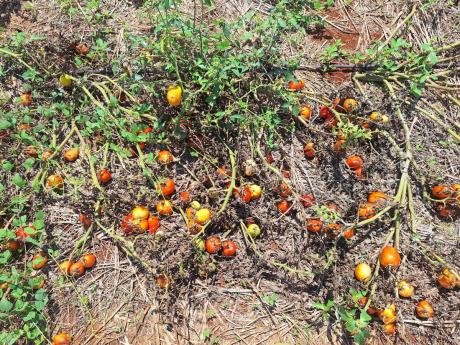

Overripe tomatoes are rotting away on farms across sections of St Elizabeth, symbolising the crushing financial losses farmers are facing. Struggling with an oversupply of crops, farmers are being forced to sell their tomatoes for a mere $15 per pound, yet a dire shortage of buyers leaves them with no choice but to watch their investment wilt away.
"It is very discouraging. I only do it because I provide employment for a few guys, and I can get back some money to buy some seeds. But there is no profit in it at this pricing right now," Junior Dyer told THE WEEKEND STAR during a visit to his Flagaman-based farm on Wednesday.
Dyer added that, although the larger "table salads" are currently going for $60 a pound, he has received offers of $20 per pound for his smaller tomatoes. He explained that, because he has spent hundreds of thousands of dollars on his farm, these price tags have been devastating.
"I have two guys working for me and they get between $4,000 and $5,000 per day. A pack of the seeds is for $15,000, and you get roughly 1,100 seedlings. But, after germination, you might get 1,000. I use Actara insecticide to wet the soil, and a pack of the small sachet is for $800," said Dyer.
In addition to that, the farmer said that he purchases and trucks irrigation water from the neighbouring farming community of Beacon. However, Dyer is hopeful that his next batch of produce will attract a higher price tag.
"The only thing that keeps me above ground is my sweet pepper. I don't ever lose with sweet pepper," he said.
Gerald Davis, another Flagaman farmer, said he has lost approximately 90 per cent of his small tomato farm because of a lack of buyers. However, unlike Dyer who trucks his water, Davis said that the trucking of irrigation water is on his long list of expenses.
"Mi buy three trucks of water for this farm and each load cost $12,000. Then mi affi turn round and pay each man $2,000 to hold the hose and I usually use six men," said Davis.
However, the farmer admitted that the current lack of buyers and the low price for produce happens whenever there is a glut.
"I have never had a good crop of tomatoes and get it sold - everything always just fades away because we don't have the buyer. These should have been sold a long time ago, but dem stay on the bush and decay," Davis said during a tour of his tomato farm.
Meanwhile, in Beacon, Javid Powell told THE WEEKEND STAR that he believes the local farming sector would greatly benefit from modular cold storage facilities. Powell bemoaned the fact that he has lost more tomatoes than he was able to sell since the start of the year.
"This is not my first time planting tomatoes, but the first time I'm losing so much. I try to get buyers but, the more you call dem, they tell you that dem not buying any. Some buyers come and buy likkle."
"I think there is just too much on the market. I think they should have a factory or something to store produce. If we had that, so much of our tomatoes wouldn't spoil," Powell said.
The agriculture ministry, last year, announced plans to reintroduce cold storage facilities to the local farming sector. A $100-million deal has been signed to construct a state-of-the-art cold storage facility in Kirkvine, Manchester. The ministry also plans to build 30 solar-powered modular facilities nationwide in the following five years, beginning with four in 2025. Plans are also being made to renovate the Coleyville cold storage facility, also in Manchester.
However, Beacon farmer Ryan Powell opposes cold storage, saying it will not benefit tomato growers.
"It is going to be hard to use cold storage for tomatoes. It can use fi mek a whole heap of things because you have tomatoes in cans, tomato ketchup and other food items. Big companies should invest in small farmers fi mek dem ketchup and stop buying the foreign one dem and put your labels dem pon it. Every country a try fi push dem own goods, so we should do it too," he appealed.