Latest News


Sonar shoes may replace white cane for visually impaired
April 30, 2026
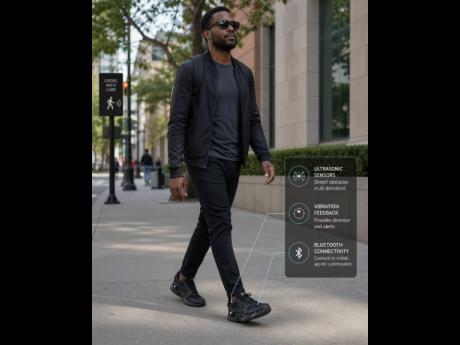

Sonar shoes could replace the trademark white cane for persons who are visually impaired.
The shoes utilises ultrasonic sensors and haptic (vibration) feedback to detect obstacles and enhance independent mobility. They were among the technologies unveiled during the two-day Regional Disability Studies Conference held at The University of the West Indies (UWI).
According to Professor Senator Floyd Morris, director of the UWI's Centre for Disability Studies, these smart shoes act as a "personal radar system", scanning the environment for hazards and alerting the user through vibrations or sounds.
"That technology is being developed to assist persons with disabilities. It is being developed by persons from one of our universities. They are working right around the clock and they are doing some refining suggestions that I made to them. One of things that you have to understand about a blind person is that we function by sound. So while it is good that the hardware is going to be giving you a beeping sound, we need to make sure that the sound is transmitted to an audio pitch so that you can hear what it is saying," he said.
The focus of the conference was on accessibility which Morris, who was a speaker, said is a fundamental issue for persons living with disabilities in the Caribbean. He stated that scholars have argued that the inaccessible nature of the Caribbean dates back the region's colonial history when persons with disabilities were seen as objects of charity and could not make any meaningful contribution to society. Morris, however, indicated that they are working on a number of assistive technologies, including the sonar shoes, to improve the quality of life for the disabled. But Morris noted that these technologies are extremely expensive.
HIGH COSTS
"They usually come from first world countries and this will attract a lot of importation cost. The vast majority of the disabled community are unemployed, so they are not readily able to purchase these technologies. Unless government makes a serious injection of capital to assist with the purchase, then we are not going to see a lot of persons with disabilities gain access to these technologies that are transforming the world," Morris said.
However, Andre Fisher, technology teacher at The Salvation Army School for the Blind, is apprehensive of the shoes' effectiveness.
"Really and truly, those technologies will never replace the cane as it provides benefits that some of these technologies cannot provide. The cane is reliable and something that you don't have to plug in or charge. There are smart canes which provide GPS access and so on. There is a device coming out that looks like a suitcase and you can push it and get information on your surroundings, and even the developer will tell you that the device cannot replace a cane. I have not heard about the shoes but I wouldn't trust it," he said.
"I also don't know how much input they got from the blind community and that is very important. Some of these companies they don't seek out that type of guidance to show them how to actually develop these things," Fisher added.
Morris, however, expressed optimism that with the various technologies emerging, the term 'blindness' could become redundant within a decade.
"The technology is improving at such a fast pace. It is giving you information at a rapid pace. For example, I have a glass can describe scenery and I can get it to scan images and it describes it to go online and get me news from the Gleaner and STAR and read it for me. I have a software on my phone called seeing eye. When I ask it to describe a picture for me, it gives me far more detailed information than I would get from a sighted person. I recently did a demonstration of it in the Parliament," he said.